Things You Can Control and Things You Cannot Control: 15 Things to Let Go Of
In This Blog, You'll Learn:
- What you can and cannot control in everyday life
- What are things you can control in relationships, work, and mental health?
- 15 things you can't control in life
- The difference between things you can control and things you can't control
- How focusing on things outside your control affects anxiety and stress
- How to stop trying to control other people's behaviors and emotions
- Why boundaries, acceptance, and emotional regulation matter
- How CBT, DBT, ACT, and anxiety therapy can help
- When to consider individual therapy for control, anxiety, and overthinking
What Are Things You Can Control and Things You Cannot Control?
Have you ever found yourself overthinking a situation, worrying about someone else's behavior, or feeling frustrated because things aren't going the way you expected?
Many people experience stress, anxiety, frustration, and emotional exhaustion when they focus on circumstances outside their control. Whether you're navigating relationship problems, family conflict, workplace stress, trauma, or major life changes, understanding what you can and cannot control can help you develop healthier coping skills and improve your emotional well-being.
Learning the difference between things I can control and things I cannot control is an important part of emotional regulation, anxiety management, setting boundaries, and building healthier relationships.
Through Cognitive Behavioral Therapy (CBT), Dialectical Behavior Therapy (DBT), Acceptance and Commitment Therapy (ACT), and individual therapy, you can learn to recognize what is within your control, accept uncertainty, and respond to life's challenges more effectively.
At Mountains Therapy, in Montclair, NJ we help individuals navigate anxiety, stress, trauma, relationship challenges, self-esteem concerns, and emotional regulation through personalized mental health counseling.
What Are Things You Can Control and Things You Cannot Control?
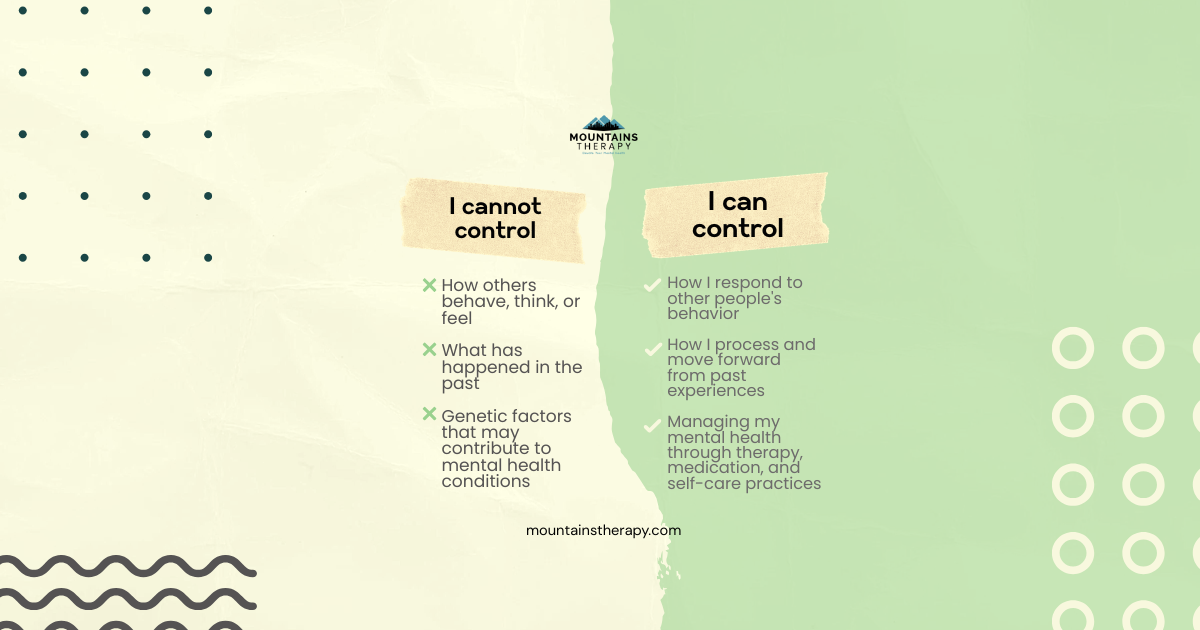
Understanding what we can and cannot control begins with recognizing the difference between our personal choices and external circumstances.Although we cannot determine every outcome in life, we can often influence how we respond, communicate, establish boundaries, and make decisions.
Things we can control generally involve our own actions, behaviors, choices, and efforts. Things we cannot control include other people's decisions, past events, unexpected circumstances, and many outcomes. However, control is not always all-or-nothing. Some situations fall into a middle category: things we can influence but cannot fully determine.
For example:
- You can control: Whether you communicate your feelings respectfully.
- You can influence: Whether a conversation becomes more productive.
- You cannot control: Whether the other person understands, agrees, or changes their behavior.
Recognizing what we can control vs. what we can't helps reduce unnecessary self-blame, improve emotional boundaries, and encourage healthier responses to stressful situations.
Things I Can Control and Things I Cannot Control: Examples
If you've been searching for things I can control things I can't control, the following examples can help you identify where to focus your energy.
Things I Can Control
- My actions and behaviors
- How I communicate
- The boundaries I establish
- How I respond to emotions
- The effort I put into relationships
- My personal values
- How I spend my time
- Whether I ask for help
- My willingness to apologize
- How I care for my mental health
- My personal goals
- How I respond to mistakes
- My willingness to learn
- Whether I seek therapy
- My decisions moving forward
Things I Cannot Control
- Other people's actions
- How others interpret my words
- Whether others respect my boundaries
- Whether difficult emotions arise
- Whether someone reciprocates
- Other people's beliefs
- Unexpected interruptions
- Whether others provide the help I want
- Whether someone forgives me
- Every symptom or emotional reaction
- The exact outcome of my efforts
- What happened in the past
- Other people's willingness to change
- Someone else's decision to seek therapy
- Everything that happens in the future
What Are 15 Things You Can't Control in Life?
One of the most important lessons in mental health is recognizing that not everything is your responsibility to change. Understanding things I cannot control does not mean becoming passive, tolerating mistreatment, or giving up on your goals. It means recognizing when your energy may be better spent on actions that support your well-being. Here are 15 things you can't control in life and why learning to accept them can support your emotional well-being.
15 Things You Cannot Control in Life
- Other People's Opinions: You cannot control how others think about you, interpret your decisions, or judge your choices. Constantly seeking approval can contribute to people-pleasing, anxiety, and low self-esteem.
- Other People's Behaviors: You cannot force someone to communicate respectfully, remain faithful, take accountability, or make healthier decisions. You can decide what behaviors you are willing to accept and how to respond.
- The Past: You cannot change past relationships, mistakes, traumatic experiences, or missed opportunities. However, you can work toward processing those experiences and developing healthier patterns moving forward.
- Other People's Emotions: You are not responsible for preventing everyone around you from feeling disappointed, angry, upset, or uncomfortable. You can be compassionate without assuming responsibility for managing someone else's emotions.
- Whether Someone Likes You: Not everyone will connect with your personality, values, or decisions. Learning to tolerate disapproval can help reduce social anxiety and people-pleasing behaviors.
- Unexpected Life Changes: Job loss, relocation, relationship changes, financial challenges, and other unexpected events can disrupt your plans. Although you may not control these circumstances, you can explore your options and seek support.
- Other People's Decisions: You cannot make someone prioritize a relationship, attend therapy, change unhealthy habits, or follow your advice.
- How Others Interpret Your Boundaries: Someone may disagree with or feel disappointed by your boundaries. Their reaction does not automatically mean your boundary is unreasonable.
- Whether Someone Apologizes: You cannot force someone to acknowledge the harm they caused or take responsibility for their actions. Your healing does not have to depend entirely on receiving an apology.
- The Future: You cannot predict every outcome, prevent every disappointment, or guarantee that things will happen according to plan. Developing tolerance for uncertainty is an important anxiety management skill.
- Other People's Expectations: Family members, romantic partners, friends, and coworkers may have expectations that conflict with your personal needs or values. You can consider their perspectives without automatically agreeing to their demands.
- Whether Someone Changes: Personal growth requires individual willingness and effort. You cannot make another person recognize unhealthy patterns or commit to change.
- Other People's Communication Styles: You cannot determine whether someone communicates openly, avoids conflict, becomes defensive, or expresses emotions effectively. You can communicate your needs and decide how to engage.
- Every Outcome of Your Efforts: Working hard, being kind, and making thoughtful decisions do not guarantee the results you want. You can control your participation and preparation, but outcomes often depend on additional factors.
- Everything That Happens Around You: You cannot control every conflict, inconvenience, emergency, or stressful event. Accepting this reality can help you focus on problem-solving rather than attempting to eliminate all uncertainty.
What Are 15 Things You Can Control in Life?
When exploring what you can control and what you can't, it can be helpful to identify the areas where you have meaningful choices. Here are 15 examples of things I can and can't control, with a focus on the actions that are generally within your influence.
15 Things You Can Control in Life
- Your Actions: You can choose behaviors that reflect your values and goals.
- Your Communication: You can practice expressing your feelings and needs respectfully.
- Your Boundaries: You can decide what limits are necessary for your emotional well-being.
- Your Effort: You can choose how much energy to invest in your responsibilities and goals.
- Your Decisions: You can make choices based on the information and resources available to you.
- Your Responses: You can practice pausing before reacting when emotionally overwhelmed.
- Your Coping Skills: You can learn strategies for managing anxiety, stress, and difficult emotions.
- Your Willingness to Seek Support: You can reach out to trusted people or mental health professionals.
- Your Personal Values: You can identify what matters most to you.
- Your Self-Talk: You can practice challenging harsh self-criticism and developing self-compassion.
- Your Accountability: You can acknowledge mistakes and work toward repairing harm.
- Your Goals: You can establish realistic goals and take steps toward achieving them.
- Your Participation in Relationships: You can decide how you show up and what you contribute.
- Your Self-Care Choices: You can make supportive decisions about rest, routines, and personal needs when circumstances allow.
- Your Willingness to Grow: You can remain open to feedback, reflection, and learning healthier behaviors.
These examples demonstrate that things we can control often involve our choices and efforts rather than guaranteed results. You may not always be able to choose your initial emotional reaction, especially when experiencing anxiety, depression, PTSD, or trauma-related symptoms. However, therapy can help you develop skills for navigating those reactions with greater awareness and self-compassion.
Why Do We Try to Control Things We Cannot Control?
Have you ever wondered why you feel the need to control everything, even when you know certain situations are outside your control? Trying to control circumstances can sometimes be an attempt to create predictability, prevent disappointment, or reduce emotional discomfort.
Common reasons include:
- Anxiety: Worrying about uncertain outcomes and attempting to prevent worst-case scenarios.
- Trauma: Feeling a heightened need for safety, predictability, or control after distressing experiences.
- Perfectionism: Believing that mistakes, uncertainty, or unexpected outcomes are unacceptable.
- Fear of rejection: Attempting to manage how others perceive you to avoid criticism or abandonment.
- People-pleasing: Feeling responsible for keeping others happy or preventing conflict.
- Low self-esteem: Relying on external validation to feel secure or confident.
- Relationship insecurity: Attempting to control interactions because of fears related to trust, rejection, or abandonment.
- Difficulty regulating emotions: Trying to change external circumstances to avoid uncomfortable feelings.
For some individuals, controlling behaviors may develop as coping strategies during periods of chronic stress, childhood adversity, emotionally unpredictable environments, or unhealthy relationships. Although these behaviors may temporarily reduce anxiety, they can also contribute to emotional exhaustion, relationship conflict, and ongoing worry.
Anxiety therapy, trauma therapy, and individual counseling can help you understand these patterns and develop healthier ways to cope with uncertainty.
How Does Trying to Control Everything Affect Mental Health?
Constantly focusing on what we can control and what we can't can become emotionally exhausting when we repeatedly attempt to change situations outside our influence. Learning what you can control and what you can't can help you recognize when problem-solving is useful and when acceptance may be a healthier response.
This pattern may contribute to:
- Anxiety and overthinking: Replaying conversations, anticipating negative outcomes, or worrying about situations you cannot change.
- Chronic stress: Feeling responsible for preventing problems or managing everyone else's needs.
- Relationship difficulties: Experiencing frustration when others do not behave according to your expectations.
- Emotional burnout: Spending significant mental energy trying to manage circumstances outside your responsibility.
- People-pleasing: Prioritizing other people's approval over your own emotional needs.
- Perfectionism: Feeling distressed when plans, relationships, or outcomes are not exactly as expected.
- Difficulty setting boundaries: Feeling guilty when you cannot meet everyone's expectations.
- Low self-esteem: Blaming yourself for situations or outcomes you could not fully control.
What Can You Control in a Relationship?
Relationships are one of the most common areas where people struggle to distinguish between what we can control and what we can't. You may want your partner to communicate differently, become more emotionally available, change certain behaviors, or understand your perspective. However, healthy relationships require two people to take responsibility for their own actions.
Things You Can Control in Relationships
- Your communication: How you express your feelings, needs, and concerns.
- Your boundaries: What behaviors you are willing to accept and how you respond when boundaries are crossed.
- Your honesty: Whether you communicate openly about your experiences and expectations.
- Your accountability: Whether you acknowledge mistakes and take responsibility for your behavior.
- Your effort: How you participate in maintaining a healthy relationship.
- Your decisions: Whether you remain in a relationship that aligns with your values, safety, and emotional needs.
Things You Cannot Control in Relationships
- Your partner's feelings: Whether they experience anger, jealousy, disappointment, or insecurity.
- Your partner's choices: Whether they remain committed, communicate honestly, or respect agreements.
- Your partner's willingness to change: Whether they recognize unhealthy behaviors and seek support.
- Your partner's attachment patterns: How they respond to closeness, vulnerability, or emotional intimacy.
- Your partner's accountability: Whether they acknowledge mistakes or apologize.
- The relationship outcome: Whether both individuals ultimately choose to continue the relationship.
Relationship therapy, couples counseling, and marriage counseling can help individuals and couples explore communication patterns, establish healthier boundaries, address recurring conflict, and understand their responsibilities within relationships.
Importantly, acceptance does not mean tolerating emotional abuse, manipulation, coercion, or controlling behavior. In abusive relationships, safety and individualized support should take priority over attempts to improve communication with an abusive partner.
How Do You Stop Worrying About Things You Cannot Control?
Learning to let go of things outside your control takes practice. The goal is not to eliminate every worry or uncomfortable feeling, but to respond differently when uncertainty arises.
1. Identify What Is Within Your Control
Identifying what I can and cannot control can help separate practical concerns from repetitive worry. Ask yourself:
- What part of this situation can I realistically change?
- Am I responsible for this person's actions or emotions?
- Is there a specific action I can take?
- Am I focusing on a possibility rather than something happening right now?
2. Challenge Unhelpful Thought Patterns
Anxiety can contribute to catastrophic thinking, excessive responsibility, and the belief that you must anticipate every possible problem. Replacing rigid beliefs with more balanced perspectives can reduce emotional distress.
CBT can help you recognize and challenge thoughts such as:
- "If something goes wrong, it will be my fault."
- "I need everyone to like me."
- "If I worry enough, I can prevent something bad from happening."
- "I should be able to fix this person's problems."
3. Practice Acceptance Without Giving Up
Acceptance means acknowledging reality as it currently exists, even when you wish things were different. Acceptance is not the same as approval, agreement, or resignation.
For example:
- "I cannot change what happened, but I can decide what I need now."
- "I cannot control someone's opinion of me, but I can act according to my values."
- "I cannot guarantee the outcome, but I can prepare and make an informed decision."
4. Establish Healthy Boundaries
Boundaries help clarify your responsibilities and protect your emotional well-being. Boundary-setting therapy and relationship counseling can help individuals develop assertive communication and reduce guilt associated with prioritizing their needs.
Examples include:
- Saying no when you do not have the capacity to take on additional responsibilities.
- Ending conversations that become disrespectful.
- Limiting contact with individuals who repeatedly violate your boundaries.
- Recognizing that you cannot solve every problem for another person.
5. Practice Emotional Regulation
When situations feel unpredictable, emotional regulation skills can help you respond more intentionally.
DBT can be especially helpful for developing distress tolerance, mindfulness,
Helpful strategies include:
- Mindfulness and grounding exercises
- Deep breathing and relaxation techniques
- Identifying and naming emotions
- Journaling about stressful situations
- Practicing self-compassion
- Taking breaks before responding to conflict
6. Focus on Actions Instead of Outcomes
Rather than asking, "How can I make sure this works out?" consider asking, "What is one helpful action I can take right now?" This shift encourages realistic problem-solving while reducing the pressure to guarantee results.
7. Seek Support Through Individual Therapy
If worrying about situations outside your control interferes with your relationships, sleep, work, or emotional well-being, therapy can help you understand underlying patterns and develop healthier coping strategies.
What Is the Circle of Control in Therapy?
The circle of control is a psychological self-reflection tool that helps individuals identify the difference between circumstances they can control, situations they can influence, and outcomes outside their control.
It is commonly used in therapy, stress management, and personal development to support emotional awareness and problem-solving.
The Three Circles of Control
1. Circle of Control – Things I Can Control
This includes your actions, choices, communication, boundaries, and efforts.
2. Circle of Influence – Things I Can Influence but Cannot Guarantee
This includes relationship dynamics, workplace interactions, conflict resolution, and shared decisions.
3. Circle of Concern – Things I Cannot Control
This includes other people's opinions, past events, unexpected circumstances, and many future outcomes.
For example, imagine you are experiencing conflict with a coworker.
- Control: You can communicate professionally and establish appropriate boundaries.
- Influence: You may help improve the working relationship through respectful communication.
- Cannot Control: You cannot force your coworker to change their attitude or behavior.
Understanding what we can control and what we can't can help you redirect energy toward meaningful actions instead of repeatedly worrying about circumstances outside your influence.
How Can Therapy Help You Focus on What You Can Control?
Therapy can help individuals understand why uncertainty feels uncomfortable, recognize unhelpful patterns, and develop healthier responses to stressful situations. At Mountains Therapy in Montclair, NJ, our therapists use evidence-based approaches to support anxiety management, emotional regulation, relationship challenges, trauma recovery, and personal growth.
- CBT – Challenging Control-Related Thoughts: CBT helps you identify unhelpful thinking patterns, including catastrophizing, excessive responsibility, perfectionism, and negative self-talk. CBT for anxiety and control issues can help you distinguish between realistic concerns and worries about situations outside your control.
- DBT – Emotional Regulation and Distress Tolerance: DBT helps you develop mindfulness, emotional regulation, distress tolerance, and interpersonal effectiveness skills. DBT for emotional regulation can help you tolerate uncertainty, manage intense emotions, and respond more effectively when circumstances do not go as planned.
- ACT – Accepting What You Cannot Control: ACT helps you develop psychological flexibility, practice acceptance, and make decisions guided by your personal values. ACT for anxiety and uncertainty can help you stop struggling with every uncomfortable thought or emotion and focus on actions that support your long-term well-being.
- Anxiety Therapy – Managing Worry and Overthinking: Anxiety counseling helps you recognize excessive worry, fear of uncertainty, reassurance-seeking, and avoidance behaviors. Therapy for anxiety and overthinking can help you develop healthier coping skills, improve problem-solving, and build greater emotional confidence.
- PTSD Therapy – Rebuilding a Sense of Safety: Trauma can affect how you perceive safety, predictability, and control. Trauma-informed therapy and PTSD counseling can help you understand trauma-related responses, process distressing experiences, and develop a greater sense of safety and personal agency.
- Relationship Therapy – Understanding Boundaries and Responsibility: Relationship counseling helps you explore communication patterns, emotional boundaries, people-pleasing, attachment concerns, and relationship expectations. Individual relationship therapy and couples counseling can help you clarify your responsibilities, establish healthier boundaries, improve communication, and build more balanced relationships.
Frequently Asked Questions About What You Can and Cannot Control
What Are Things You Can Control in Life?
Things you can control generally include your actions, communication, boundaries, personal decisions, effort, and willingness to seek support. Although you cannot guarantee outcomes, you can make choices that align with your values and emotional well-being.
What Are Things You Cannot Control?
Things you cannot control include other people's opinions, decisions, emotions, behaviors, past events, unexpected circumstances, and many future outcomes. Recognizing these limitations can help reduce anxiety, frustration, and excessive responsibility.
What Is the Difference Between Things I Can Control and Things I Cannot Control?
The difference between things I can control and things I cannot control involves identifying what depends primarily on your own choices versus what depends on other people or external circumstances. Some situations can be influenced without being fully controlled.
Why Do I Worry About Things I Cannot Control?
Worrying about things outside your control may be associated with anxiety, perfectionism, fear of uncertainty, trauma, people-pleasing, or previous experiences involving unpredictability. Therapy can help you understand these patterns and develop healthier coping strategies.
How Do I Accept Things I Cannot Control?
Acceptance involves acknowledging a situation without continuously fighting against its reality. Mindfulness, self-compassion, CBT, DBT, ACT, and boundary-setting strategies can help you respond more effectively to uncertainty.
What Can I Control When I Have Anxiety?
Although you may not be able to control when anxiety symptoms appear, you can practice coping skills, seek professional support, challenge unhelpful thought patterns, establish routines, and make decisions that support your mental health.
What Can You Control and What Can't You Control in Relationships?
You can control your communication, boundaries, honesty, accountability, and relationship decisions. You cannot control your partner's feelings, behaviors, choices, willingness to change, or commitment to the relationship.
Can Therapy Help With Control Issues and Overthinking?
Yes. CBT, DBT, ACT, anxiety therapy, and trauma-informed counseling can help individuals recognize unhelpful control patterns, manage uncertainty, improve emotional regulation, and develop healthier coping strategies.
Is Letting Go of Control the Same as Giving Up?
No. Letting go of control means recognizing the difference between taking meaningful action and attempting to guarantee an outcome. You can remain proactive, establish boundaries, and pursue goals without assuming responsibility for everything that happens.
Why Is It Important to Understand What We Can Control and What We Can't?
Understanding what we can control and what we can't can reduce unnecessary worry, encourage healthier boundaries, improve emotional regulation, and help individuals focus on decisions that support their personal values and well-being.
Therapy for Anxiety, Overthinking, Control Issues, and Emotional Regulation in Montclair, NJ
Learning what you can and cannot control can be an important step toward reducing anxiety, managing stress, improving relationships, and developing healthier emotional boundaries. If you frequently find yourself worrying about the future, feeling responsible for other people's emotions, struggling with perfectionism, or trying to prevent every possible negative outcome, individual therapy can help. At Mountains Therapy, we provide compassionate, personalized mental health counseling for teens, adults, couples, and families.
Our therapists support individuals experiencing:
- Anxiety and chronic worry – Managing overthinking, uncertainty, and excessive responsibility.
- Stress and emotional burnout – Developing healthier coping strategies and realistic expectations.
- Trauma and PTSD – Understanding how past experiences influence safety, trust, and control.
- Relationship difficulties – Improving boundaries, communication, and relationship patterns.
- People-pleasing and low self-esteem – Building confidence, assertiveness, and self-compassion.
- Perfectionism and control issues – Challenging rigid expectations and increasing psychological flexibility.
- Emotional regulation difficulties – Developing coping skills for frustration, uncertainty, and distress.
- Life transitions – Navigating changes in relationships, careers, family dynamics, and personal identity.
We offer in-person therapy in Upper Montclair, New Jersey, and online therapy in NJ our counselors are authorized to practice.
You do not have to control everything to feel more confident in how you navigate life. Learning to recognize what is within your influence can help you make healthier decisions, establish meaningful boundaries, and approach uncertainty with greater self-compassion.
Ready to focus on what you can control?
Schedule a Therapy Appointment With Mountains Therapy and take the next step toward managing anxiety, reducing overthinking, and improving your emotional well-being.
ELEVATE YOUR MENTAL HEALTH BLOG
Mountains Therapy